



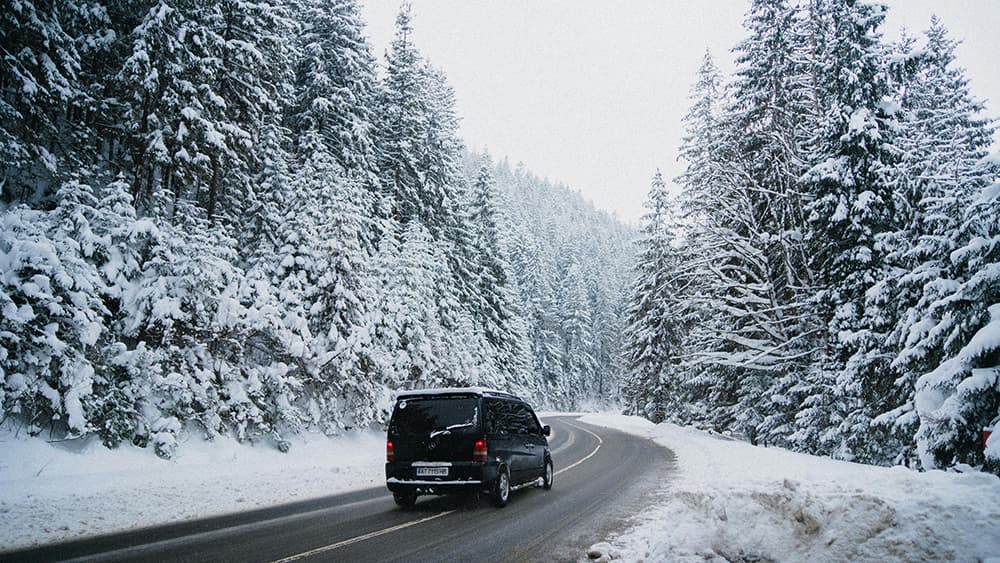
Gudauri and Bakuriani are Georgia's two winter playgrounds and the drives to reach them are part of the appeal — one traces the dramatic Georgian Military Highway through the Greater Caucasus, the other climbs through forest and spa towns in the south. Neither is technically difficult for a prepared driver, but winter in the mountains is unforgiving when you are not ready. This is the realistic plan used by merent's guests and drivers every season from December to March.
When the roads are open
The Tbilisi–Gudauri road, known as the Georgian Military Highway or E117, is kept open year-round. The only section that ever closes is the summit around the Cross Pass at 2379 m, and even that is only for a few hours during active snowstorms or scheduled avalanche clearance. Bakuriani is reached from the Tbilisi–Batumi highway via Khashuri and then a 28 km climb up a forested mountain road. The Bakuriani access is shorter, lower and therefore safer than the route to Gudauri, and genuine closures there are very rare.
Winter tyres: why they matter more than drive type
From 1 December to 1 March, winter tyres are strongly recommended for all mountain drives and mandatory on some sections by temporary decree during heavy snowfall. merent fits winter tyres on request at no extra cost — confirm this at booking. Do not accept a car with all-season tyres for a winter mountain trip; the physics are simple — below 7 °C summer compounds harden and grip collapses. All-wheel drive is a bonus but not a substitute for the right rubber, and front-wheel-drive cars on proper winter tyres handle the Gudauri road perfectly well.
Snow chains: useful but rarely essential
Chains are rarely needed on the paved main road to Gudauri or Bakuriani — the Georgian road services clear both routes aggressively within hours of any storm. Where chains are genuinely useful is the last kilometre to a specific guesthouse on an unpaved side road, or the Gudauri back routes toward Chaukhi and Juta. merent lends chains free of charge during the winter season; ask for them at booking and we include them in the boot with fitting instructions. Practise putting them on once on a dry driveway before you need them in a blizzard at −10 °C.
Pre-departure checklist
A realistic winter checklist, item by item, before leaving Tbilisi: a full tank of fuel, windscreen washer fluid rated for −25 °C (merent tops this up in winter), a plastic ice scraper, a can of de-icer spray in the glovebox, a phone charging cable in the 12 V socket, a warm jacket and gloves on the back seat even if the forecast is mild, and at least a litre of drinking water. Check tyre pressure at a station in Tbilisi before you go — cold temperatures drop pressure by roughly 1 psi per 10 °C and underinflated tyres grip worse on snow than properly inflated ones.
Checking the weather before you go
Two sources are worth bookmarking. Windy.com gives a visual forecast of snow, wind and temperature along the entire route. The Road Department of Georgia publishes live status updates for the Cross Pass at roads.gov.ge — it is in Georgian but translates easily and is more reliable than rumour. If the pass is flagged yellow or red, simply delay your trip by a few hours. Storms typically pass through in four to eight hours and conditions afterwards, with a freshly ploughed road and blue sky, are often the best of the season.
Driving the Georgian Military Highway
The road climbs gently from Tbilisi to Ananuri (1 hour, the beautiful reservoir castle is worth the photo stop), then to Pasanauri (another 40 minutes, the halfway restaurant cluster). The hardest 20 km are between Pasanauri and Gudauri — tight switchbacks, 8 % gradients, and frequent heavy trucks headed north toward Russia. Drive the switchbacks at 40–60 km/h, keep distance from trucks, and never overtake on a blind corner. If visibility drops below 50 m, pull into Pasanauri and wait; the restaurants there are happy to seat you for a plate of khinkali and warm broth while the storm passes.
The Cross Pass itself
At 2379 m, the Cross Pass is the highest point of the drive. Snow accumulates deeply on either side of the road in mid-winter — walls of ploughed snow two to three metres high are routine in January and February. The road itself is usually clear, but patches of ice form at dawn and after dark where shaded sections stay cold. Slow down, use a lower gear for engine braking on descents, and resist the urge to test your brakes on a descent curve. Diesel cars in particular should gear down rather than riding the brakes for 10 km of descent, which can overheat them.
Driving to Bakuriani
Bakuriani is approached from Khashuri, 140 km west of Tbilisi on the E60. Turn south at Khashuri onto the signed Bakuriani road, which climbs 28 km through pine forest with smooth asphalt almost all the way. Borjomi, a famous spa town, sits halfway — it is worth a coffee stop even if you are not staying there. The road is well maintained in winter and closures are extremely rare; the trip from Tbilisi to Bakuriani typically takes 3 to 3.5 hours in any weather, and a compact car on winter tyres handles it with no difficulty at all.
Parking at both resorts
Gudauri's hotels at the base of the lifts and at the upper station include heated, covered parking in the room rate at most mid-range and luxury properties. Budget guesthouses park on a cleared outdoor lot — expect to brush snow off the car every morning. Bakuriani's parking is almost all outdoor street or hotel lot. Always clear the windscreen, side mirrors and roof before driving off — a chunk of ice sliding off a rental car at speed can break the windscreen of the car behind and such damage is not covered by any insurance package.
If you get stuck
Call merent's 24/7 support line first, not a passing tow truck. Local tow services on the Cross Pass are informal and sometimes charge 500 GEL for a recovery that should cost 100. We dispatch a trusted recovery vehicle within 2–3 hours to either resort, cover the recovery fee under your insurance if the cause is weather rather than driver error, and stay on the line with you until help arrives. If you are genuinely stranded overnight by a closed pass, Pasanauri guesthouses usually have rooms available at short notice and we help coordinate the stay.
Returning safely to Tbilisi
Plan the return drive for mid-morning, not dawn. The roads are most slippery between sunrise and 10:00 when overnight frost has not yet lifted from shaded curves. Leaving Gudauri at 10:30 puts you back in Tbilisi for a late lunch in dry conditions and good light. Never attempt the Cross Pass southbound in a sudden storm — the descent is steeper than the climb and more dangerous in poor visibility, and the queue of trucks at the top can stretch for kilometres.